
Ottoman Gold-Damascened Steel Calligrapher’s Scissors
Ottoman Gold-Damascened Steel Calligrapher’s Scissors
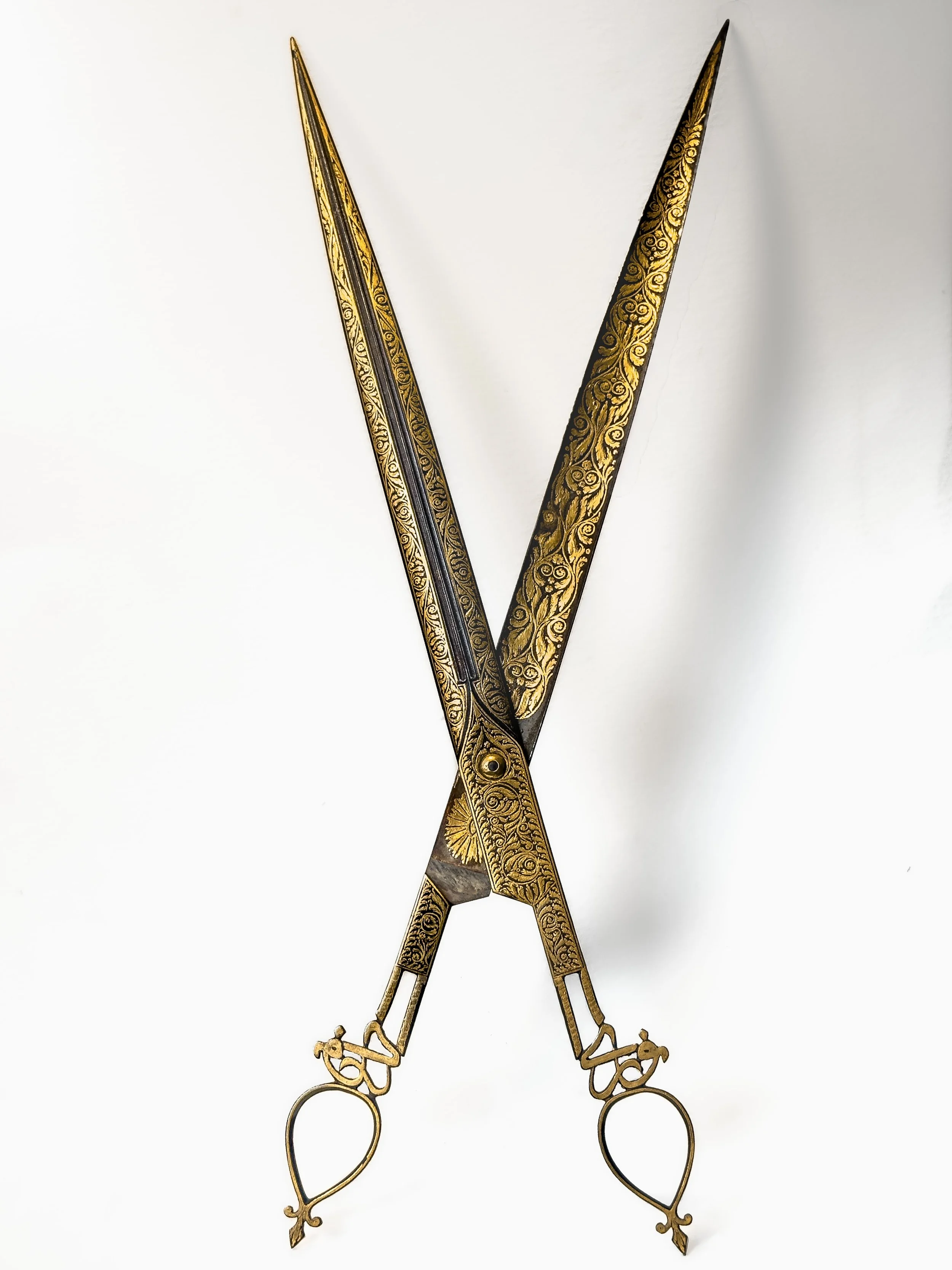
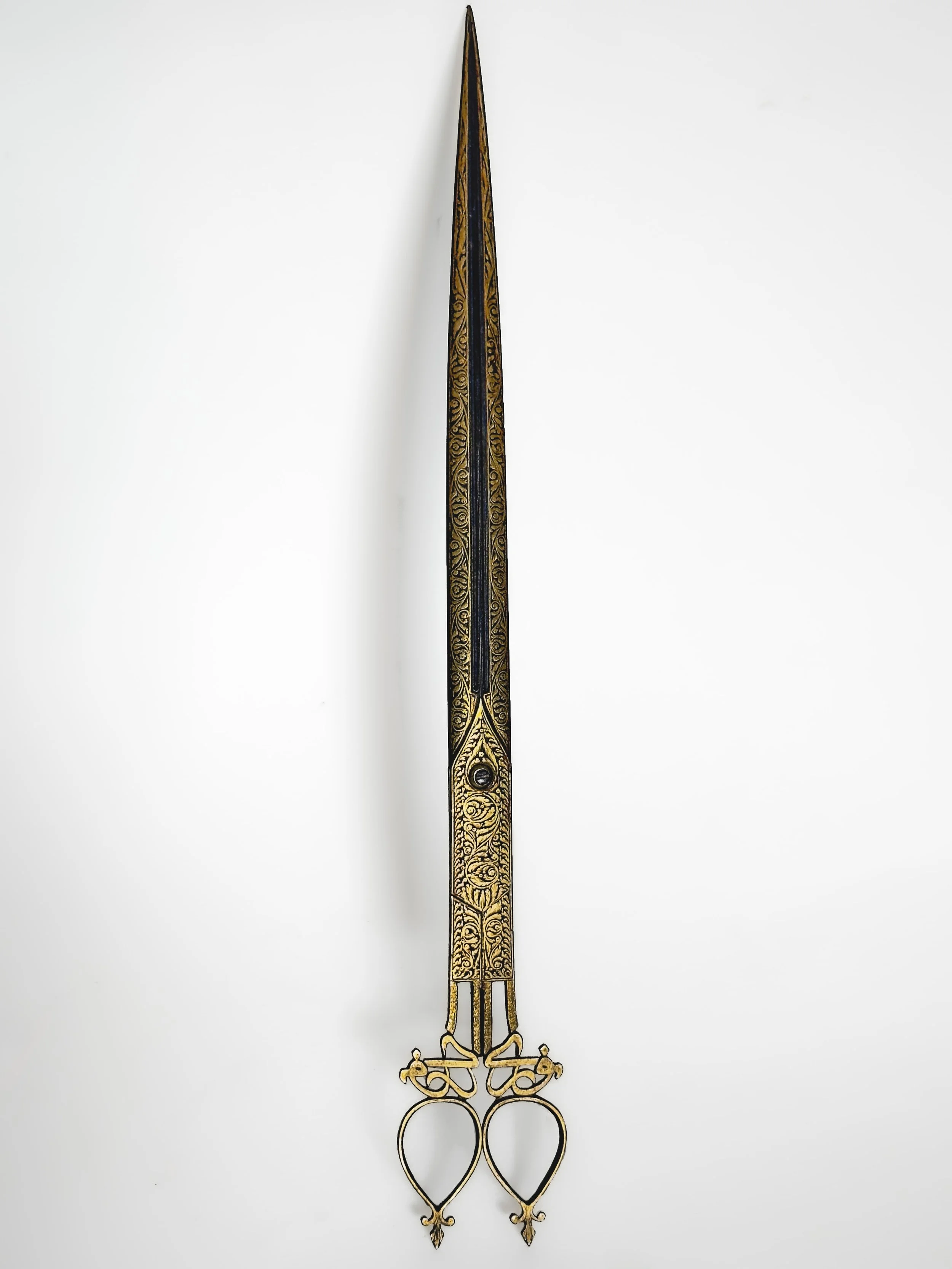
Ottoman Gold-Damascened Steel Calligrapher's Scissors (Makas), 11.25 x 1.5 in, Turkey (Istanbul). 19th c. “O Opener!” (“يا فتّاح”, Yā Fattāḥ), one of the ninety-nine Beautiful Names of God (al-Asmā' al-Ḥusnā), is rendered at the junction of each bow with the blade shaft in mirrored thuluth calligraphy, arranged as a bilateral composition across the two bows so that the invocation reads symmetrically when the scissors are viewed open or closed.
At this level of workmanship and full-surface gold damascening, such scissors are best understood as tools of the Ottoman elite, used by calligraphers, viziers, treasurers, chief secretaries, rulers, and others whose professions centered on writing in or near the palace, and would have been accessible only to patrons and practitioners operating at that upper tier.
Each arm of the scissors, including the finger bow, is formed from a single continuous length of steel. This large pair of calligrapher's scissors of blued steel construction has its entire surface (blades, shoulders, and interior faces) densely damascened in high-carat gold with composite arabesque scrollwork incorporating hatayi palmettes, split saz leaves, and spiral-stem rosettes characteristic of the Ottoman court workshop tradition of the nineteenth century.
The long, slender, symmetrically tapered blades, ground hollow on their inner faces and terminating in fine points, are of the form associated specifically with the cutting of prepared paper to sheet size and the trimming of narrow paper ribbons for decorative calligraphic borders. Within this larger ensemble of professional tools owned by an Ottoman hattat, these scissors functioned as a specialist paper instrument alongside the reed pen (kalem), penknife (kalemtraş), cutting slab (makta), burnisher (mühre), belt-worn pen case and inkwell (divit), and cylindrical carrying case (kubur), each purpose-built and a candidate for comparable refinement.
The blade ornament (continuous spiraling arabesque with isolated hatayi blossoms, rosette punctuation, and defined spine lines) belongs to the dense floral damascene vocabulary standardized in the late eighteenth through mid-nineteenth century and is stylistically distinct from the more open-lattice trellised patterns typical of contemporary Persian production. Parallel examples of gold-damascened calligrapher's scissors with mirrored Yā Fattāḥ inscriptions in the Metropolitan Museum of Art, New York, and in the Museum of Turkish and Islamic Arts, Istanbul, provide the basis for dating this pair to the 19th century and for confirming an attribution to Istanbul rather than a provincial or non-Ottoman center.