
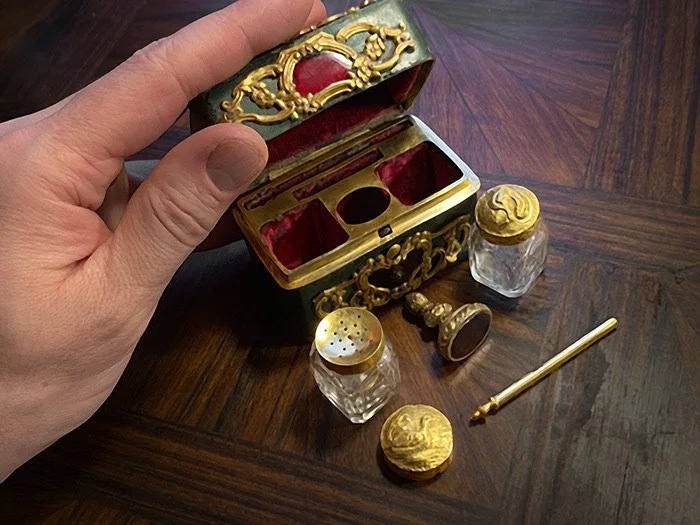
This sumptuous nécessaire features gilt copper mounts framing red glass plaques with silver foil backing. Inside there is a mirror and elements for writing; bottles, one for ink and one for sand or pounce for blotting, a pencil or stylus holder and a red glass fob seal, not engraved. The wooden body of the box is covered in green shagreen and the metal mounts and fittings are all gilt copper.
This particular use of red glass in this manner is rare and unusual and I was unable to locate any other comparable examples in the literature. The red glass plaques are flat with gently sloping edges and are silver foil backed to add a radial light burst effect. Due to the saturation of color and relative thickness of the glass they evoke a jewel-like quality.
A 'nécessaire' was an luxury object designed to hold a range of scent bottles, cosmetics, grooming tools or writing implements for portable use. Various configurations were made in a range of luxury materials. In this example green shagreen, gilt copper, lead crystal, mirror, and most notably large ruby-like glass plaques were combined to make a delightful writing kit.
Apparently unmarked.
2.78x2.33x1.84 in (7.07 x 6 x 4.7 cm)
Condition:
Possibly the seal fob is a not original to the grouping. All the attached gilt elements are secure. The red glass plaques are secure and free of cracks. The front panel has two red glass plaques, the upper one may have had the foil replaced at one time. The shagreen has some losses and repairs on the edges and there has been in painting in these areas of loss. One rivet missing on back hinge, the hinge is still very secure. The mirror has some age spots and discoloration. The piece has been waxed with conservators wax.
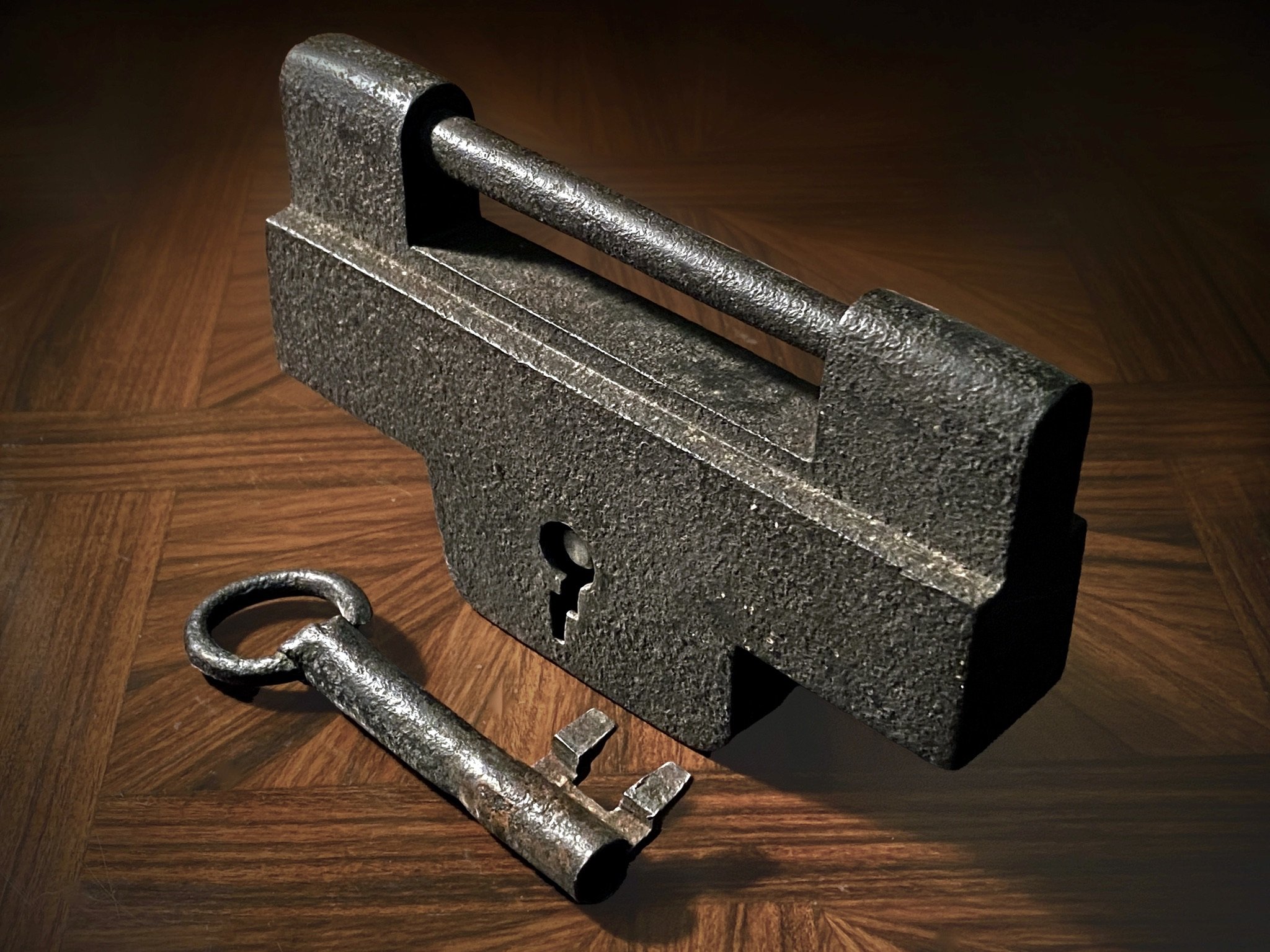
This type of padlock is a synthesis of both European lock design and traditional Japanese and Asian locking systems. The keyhole and skeleton key are familiar European designs, while the barbed-slide bolt internal mechanism is traditionally Asian. The spring-loaded internal bolts are pressed down with the rotation of the key, allowing the bolt to slide out. In traditional Asian lock design, the keys slide through the keyhole and are typically inserted into the left or right side of the lock body. These keys do not resemble typical European keys, as they do not rotate to engage the lock’s internal mechanism.
Substantial and well-made, this object testifies to the meticulous craftsmanship of everyday items in Meiji-era Japan.
Marks: Apparently unmarked.
6.5 x 3.75 x 1.25 in (16.51 x 9.6 x 3.2 cm)
Condition: Excellent with original patina, unrestored.

Rectangular form with rounded sides for striking flint. Lid fitted with spring closure and chased and engraved with a recumbent hunting dog with trees.
Matching double "XX" stamped on inside of lid as well as inside compartment.
1.98 x 1.26 x 0.5 in (5.03 x 3.3 x 1.3 cm)
Bramah Padlock with pair of original keys. Signed “J. Bramah” “Patent”, reverse engraved differ no. “579”. Brass and iron. By Bramah Lock Company, London. 18th c. (Made circa 1784–1798, probably at 124 Piccadilly). Provenance: D. Taylor Collection.[1][2]
Bramah Security Equipment Ltd. in London still operates today and has reviewed this padlock and its original keys against its internal archive records, dating the set to 1784–1798. This padlock represents a rare early 18th c example of the famous locksmith’s design.[1]
Early locks were stamped “I (or J) Bramah. Patent”. “J. Bramah” and “Patent” are stamped on the front of this padlock, matching the early marking configuration documented in Bramah’s own chronological history for the first period of the Bramah Lock Company, when the firm was operating from 124 Piccadilly.[2][1]
The “579” engraved on the reverse in copperplate roundhand is, in the company’s assessment today, probably a differ number – a system the firm still uses as the specific identifier for a lock’s unique key, registered by the company and reproducible only against a verified client signature on file.[1]
These elements, taken together with hand-assembly marks such as a “V” register mark on the underside of the shackle and the use of iron keys (later replaced by steel), place this padlock in the company’s early, largely hand-made phase.[2][1]
Patented by Joseph Bramah (1748–1814) in 1784, his design was one of the first true high-security locks. The lock’s signature brass raised cylindrical keyhole could be found on his padlocks, securing luggage, writing boxes, ledger books, and fine furniture, and the basic design remains in use today. In the same year he started the Bramah Lock Company, soon moving to 124 Piccadilly in London. In the early years, before Henry Maudslay – now regarded as a founding father of the machine‑tool industry of the Industrial Revolution – joined the firm in 1789 to mechanise production, the locks were made and assembled largely by hand in small numbers.[3][4][5][2]
Bramah’s Challenge: “The artist who can make an instrument that will pick or open this lock shall receive 200 guineas the moment it is produced.”[5][6]
By 1790 Bramah turned the lock’s reputation for being unpickable into public theater by hanging a painted sign and a special “challenge padlock” in the window at 124 Piccadilly, offering a reward of 200 guineas to anyone who could pick it open. This challenge padlock used 18 sliders rather than the usual four to six, yielding more than 470 million possible key permutations and making the chance that two keys would operate the same lock effectively nil.[6][5]
In 1851, more than sixty years after Joseph Bramah issued the challenge, Alfred Charles Hobbs arrived in London as the representative of Day & Newell of New York to demonstrate their Parautopic safe lock at the Great Exhibition; his unexpected public defeat of a Chubb Detector lock on the vault door of the Depository of Valuable Papers in Westminster in 25 minutes before eleven witnesses made headlines.[7][8][9]
Hobbs later took on Bramah’s challenge padlock. It took 51 hours over 16 days, with custom tools, for Hobbs to pick Bramah’s challenge padlock and claim the prize. The event was widely reported under headlines such as “The Pick Lock Question” and later remembered as the Great Lock Controversy, a spectacle that ultimately underscored both the ingenuity of Bramah’s original design and the shifting standards of security in the mid‑nineteenth century that followed its defeat.[9][10][5]
Sources
[1] [PDF] A Chronological History of Bramah Locks 1784 to 2002 https://www.bramah.co.uk/Chronological%20History.pdf
[2] Bramah - Antique Box Guide https://www.antiqueboxes.org/bramah/
[3] [PDF] Industrial biography : iron workers and tool makers https://archive.org/download/industrialbiogra00smiluoft/industrialbiogra00smiluoft.pdf
[4] Joseph Bramah by Samuel Smiles - Graces Guide https://www.gracesguide.co.uk/Joseph_Bramah_by_Samuel_Smiles
[5] Bramah's 'Challenge Lock' - Antique Box Guide http://www.antiquebox.org/bramahs-challenge-lock/
[6] Bramah lock - Wikipedia https://en.wikipedia.org/wiki/Bramah_lock
[7] Newell Parautoptic Lock - 1851 - Historical Safe Locks and Keys https://safelockcollector.com/safe-locks/newell-parautoptic-lock-1851/
[8] Chubb Detector Lock - Antique Box Guide https://antiqueboxes.org/chubb-detector-lock/
[9] Hobbs and His Lock Picks: The Great Lock Controversy of 1851 http://www.todayifoundout.com/index.php/2014/06/great-lock-controversy-1851/
[10] The Man Who Picked Victorian London's Unpickable Lock https://www.mentalfloss.com/article/501820/man-who-picked-victorian-londons-unpickable-lock