
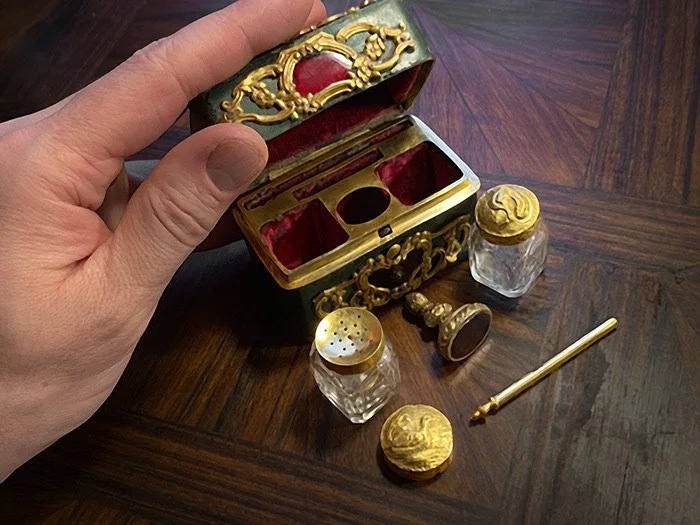
This sumptuous nécessaire features gilt copper mounts framing red glass plaques with silver foil backing. Inside there is a mirror and elements for writing; bottles, one for ink and one for sand or pounce for blotting, a pencil or stylus holder and a red glass fob seal, not engraved. The wooden body of the box is covered in green shagreen and the metal mounts and fittings are all gilt copper.
This particular use of red glass in this manner is rare and unusual and I was unable to locate any other comparable examples in the literature. The red glass plaques are flat with gently sloping edges and are silver foil backed to add a radial light burst effect. Due to the saturation of color and relative thickness of the glass they evoke a jewel-like quality.
A 'nécessaire' was an luxury object designed to hold a range of scent bottles, cosmetics, grooming tools or writing implements for portable use. Various configurations were made in a range of luxury materials. In this example green shagreen, gilt copper, lead crystal, mirror, and most notably large ruby-like glass plaques were combined to make a delightful writing kit.
Apparently unmarked.
2.78x2.33x1.84 in (7.07 x 6 x 4.7 cm)
Condition:
Possibly the seal fob is a not original to the grouping. All the attached gilt elements are secure. The red glass plaques are secure and free of cracks. The front panel has two red glass plaques, the upper one may have had the foil replaced at one time. The shagreen has some losses and repairs on the edges and there has been in painting in these areas of loss. One rivet missing on back hinge, the hinge is still very secure. The mirror has some age spots and discoloration. The piece has been waxed with conservators wax.
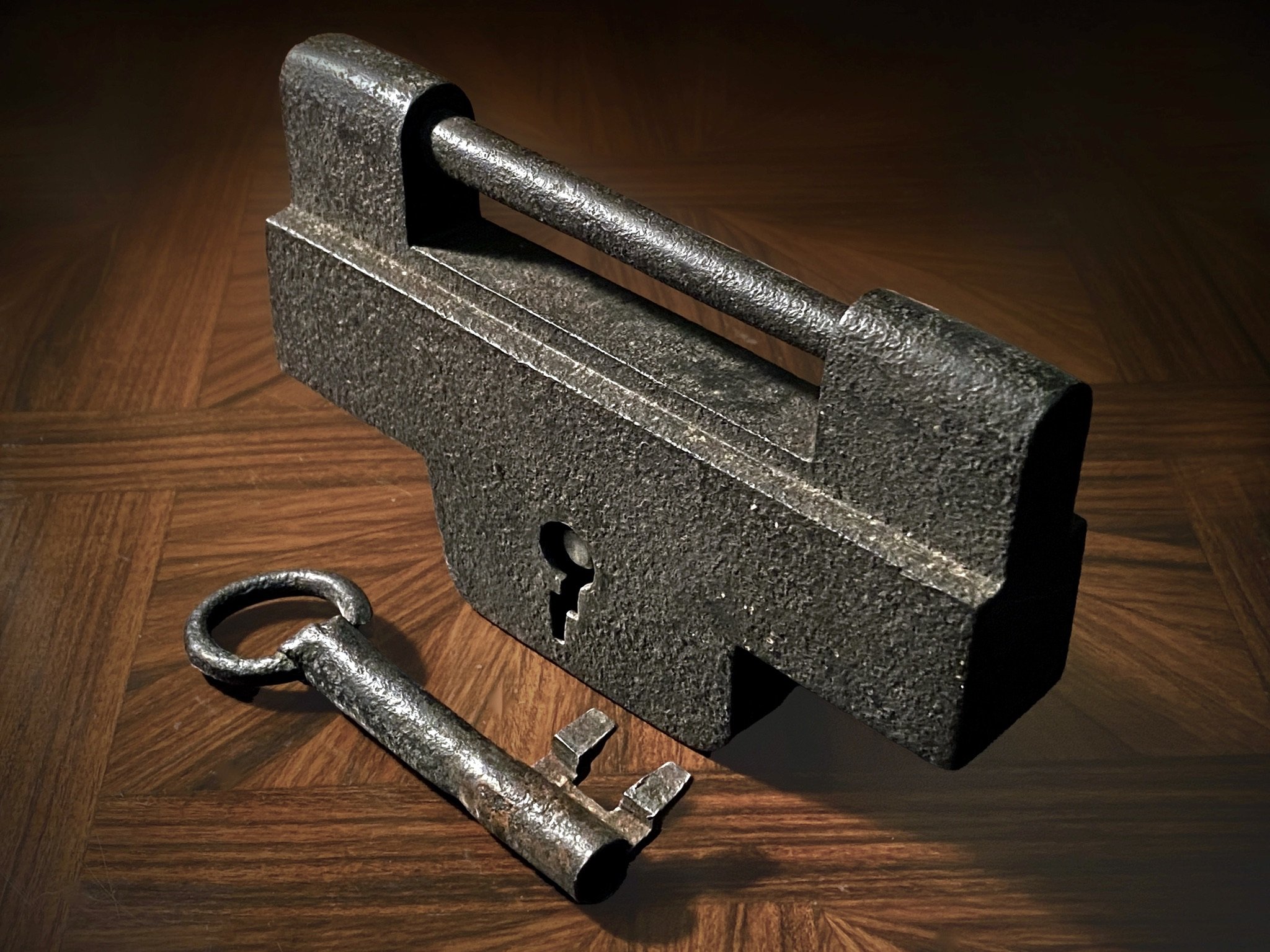
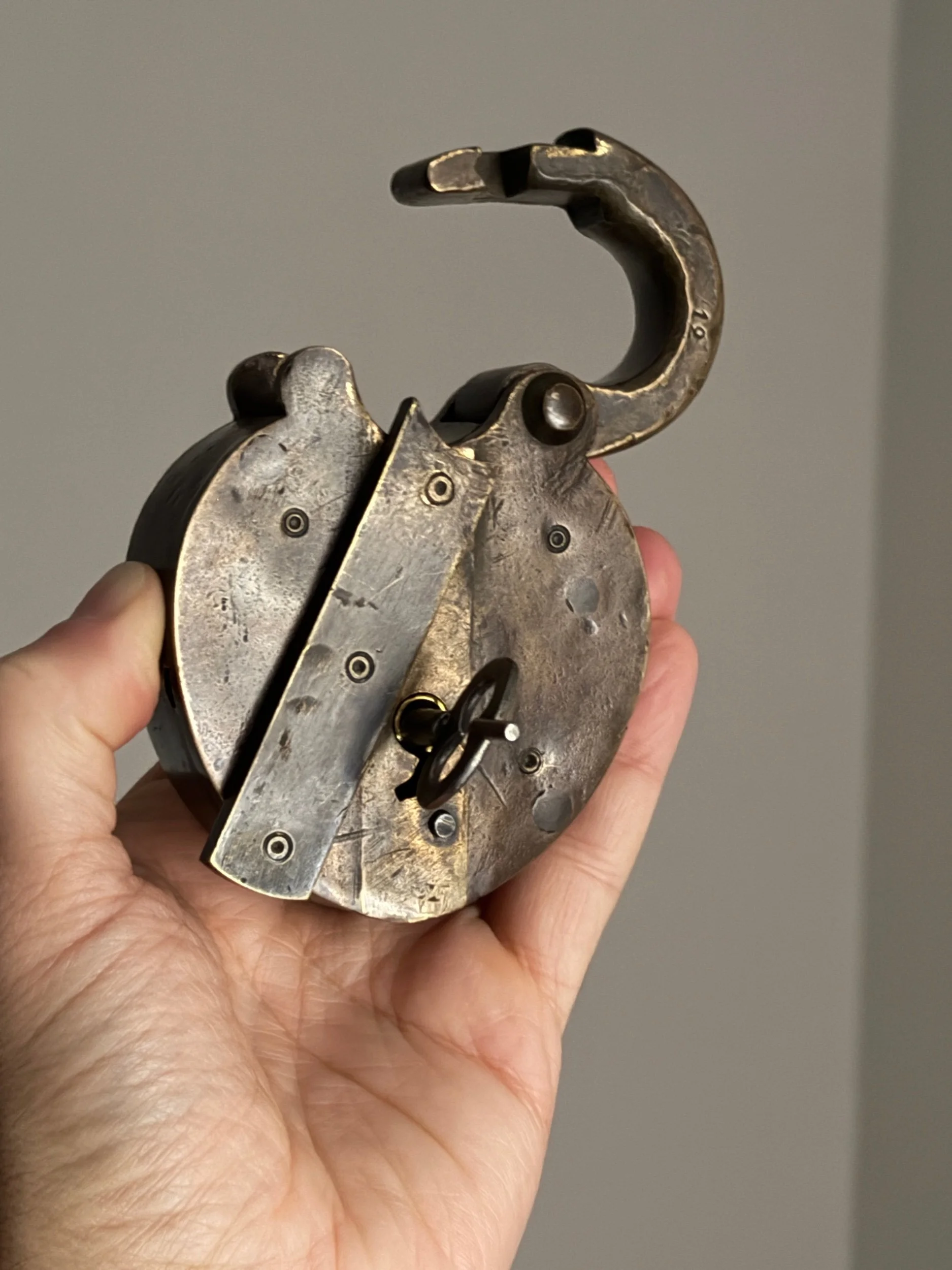
This type of padlock is a synthesis of both European lock design and traditional Japanese and Asian locking systems. The keyhole and skeleton key are familiar European designs, while the barbed-slide bolt internal mechanism is traditionally Asian. The spring-loaded internal bolts are pressed down with the rotation of the key, allowing the bolt to slide out. In traditional Asian lock design, the keys slide through the keyhole and are typically inserted into the left or right side of the lock body. These keys do not resemble typical European keys, as they do not rotate to engage the lock’s internal mechanism.
Substantial and well-made, this object testifies to the meticulous craftsmanship of everyday items in Meiji-era Japan.
Marks: Apparently unmarked.
6.5 x 3.75 x 1.25 in (16.51 x 9.6 x 3.2 cm)
Condition: Excellent with original patina, unrestored.

Rectangular form with rounded sides for striking flint. Lid fitted with spring closure and chased and engraved with a recumbent hunting dog with trees.
Matching double "XX" stamped on inside of lid as well as inside compartment.
1.98 x 1.26 x 0.5 in (5.03 x 3.3 x 1.3 cm)
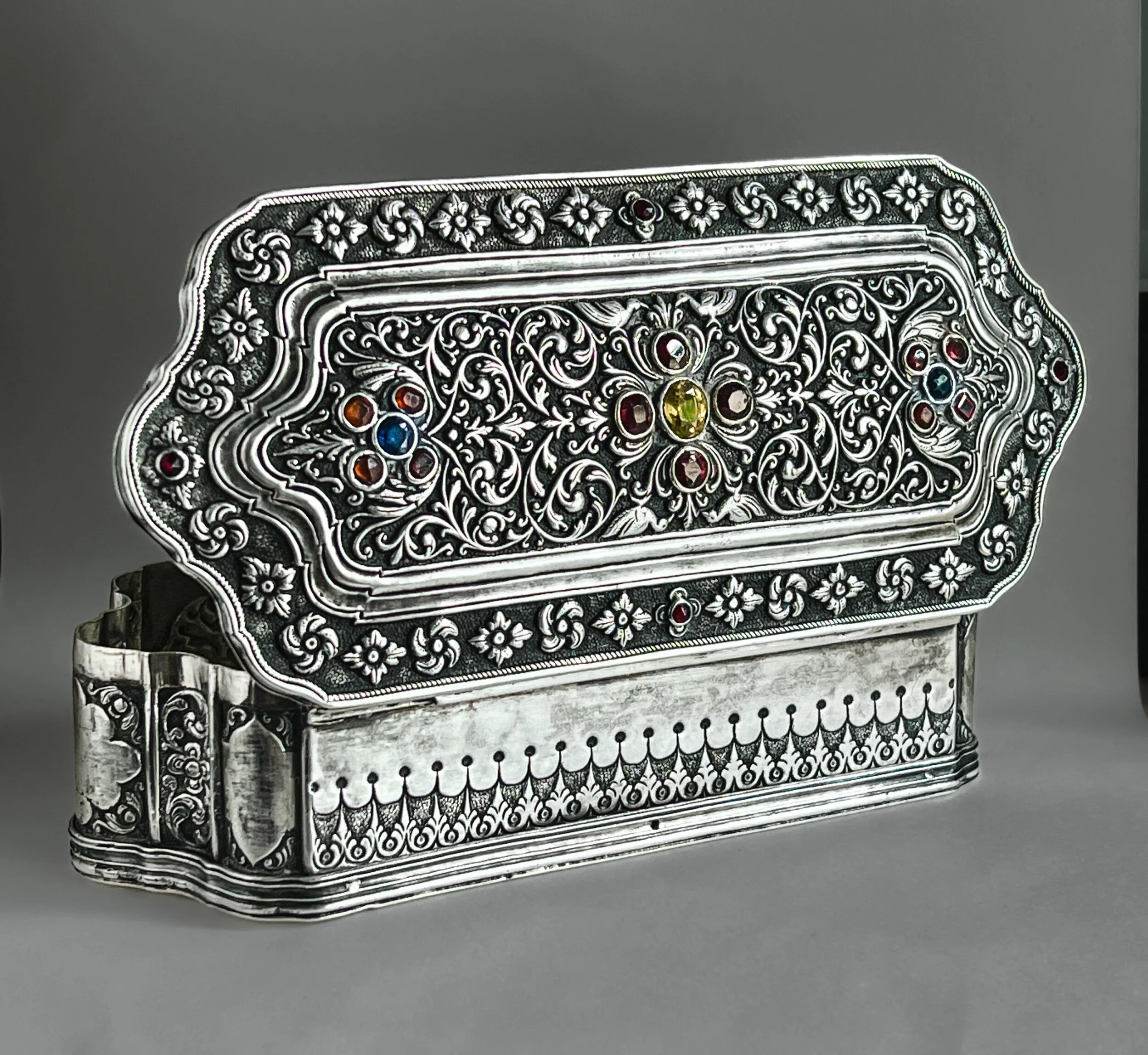
This exceptionally fine box is chased with scrolling filigree, cartouches with pairs of birds, and vegetal motifs. The box has an oblong shape, with a hinged lid and is constructed from sheets of silver. The body of the box is sensitively joined to a base frame and secured with silver rivets. The lid is slightly raised and rounded. The central motif features four birds surrounded by deeply chased and rounded designs. The lid is bordered by alternating flower motifs interspersed with stipple work. The outer edge framed by a miniscule twisting silver wire that traces the profile of the lid. The lid is set with nineteen natural gemstones, including sapphires and garnets. The purity of the silver is high and combined with the use of gemstones suggests it was intended for a high-status client. Similar designs are representative of the silverwork of Kandy.. Apparently unmarked
This is a very rare example to be set with gemstones. I am aware of only one other such example made in this style that is set with gemstones in such a manner.
6.25 x 1.75 x 2.75 in (15.88 x 4.5 x 7 cm)
Condition: Excellent, very minor wear to hinge. Some gems have some wear and flea bites.
Literature:
Mediaeval Sinhalese Art, Ananda K. Coomaraswamy - 3rd ed. - Ceylon Pantheon Books 1979 - xvi, 344 p. 53 plates, ill. (Reprint, Department of Government Printing, Sri Lanka, July 2012)
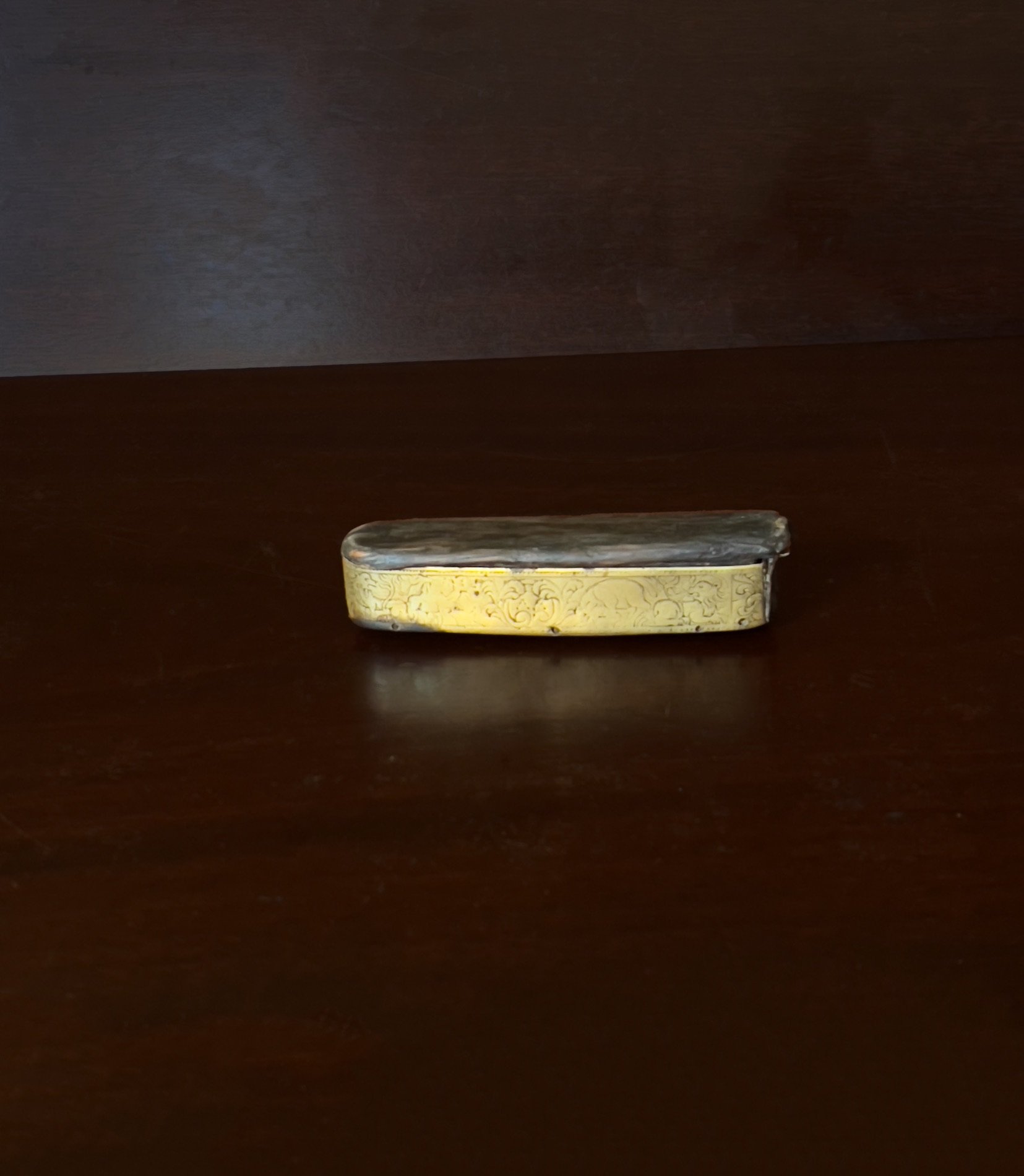
A portion of a powder horn, remade into a long box with a wooden lid. The brass element features engravings of various animals, including camels and unicorns.
Books like Edward Topsell's :"History of Four-Footed Beasts (1607) and History of Serpents :(1608), along with Joannes Jonstonus’s "A Description of the Nature of Four-Footed Beasts" (1678), translated into English by J.P., further promoted the use of 'exotic animals' in heraldry. These works also influenced needlework, inlay, and other decorative arts that embraced intricate patterns and imaginative designs, often with figures engraved in brass to enhance their visual appeal.
Marks: Apparently unmarked
4.81 x 0.95 x 1.02 in (12.22 x 2.5 x 2.6 cm)
Condition: Rubbed
Conservation: Wooden lid and bottom section are later replacements. Some rivets likely replaced.
Literature: For similar style engravings, see: JONSTONUS, Joannes, and P., J.. A Description of the Nature of Four-Footed Beasts, with their figures engraven in brass ... Translated into English by J. P.. Netherlands, Widow of John Jacobsen Schipper & Stephen Swart, 1678.

Exquisite French casket made for export to the Persian market. On all sides the Qajar-themed decorative motifs depict a range of characters engaged in various activities including a man on a horse with a lance. Birds can be found hidden in flourishes and a beast and dragon are entwined within a cartouche in a struggle against a backdrop of paradisaic floral and botanical tracery and arabesques. The lid encircled in a decorative border.
This casket captures the unique export items made in Europe prior to the fall of the Qajar Dynasty in Persia in the first quarter of the 20th century.
Marks: Apparently unmarked.
6.5 x 3.65 x 3.46 in (16.51 x 9.3 x 8.8 cm)
Condition: Polished at one time. Inner lid lacking lining. One hinge has loose rivet.
Conservation: Rubbed and Waxed
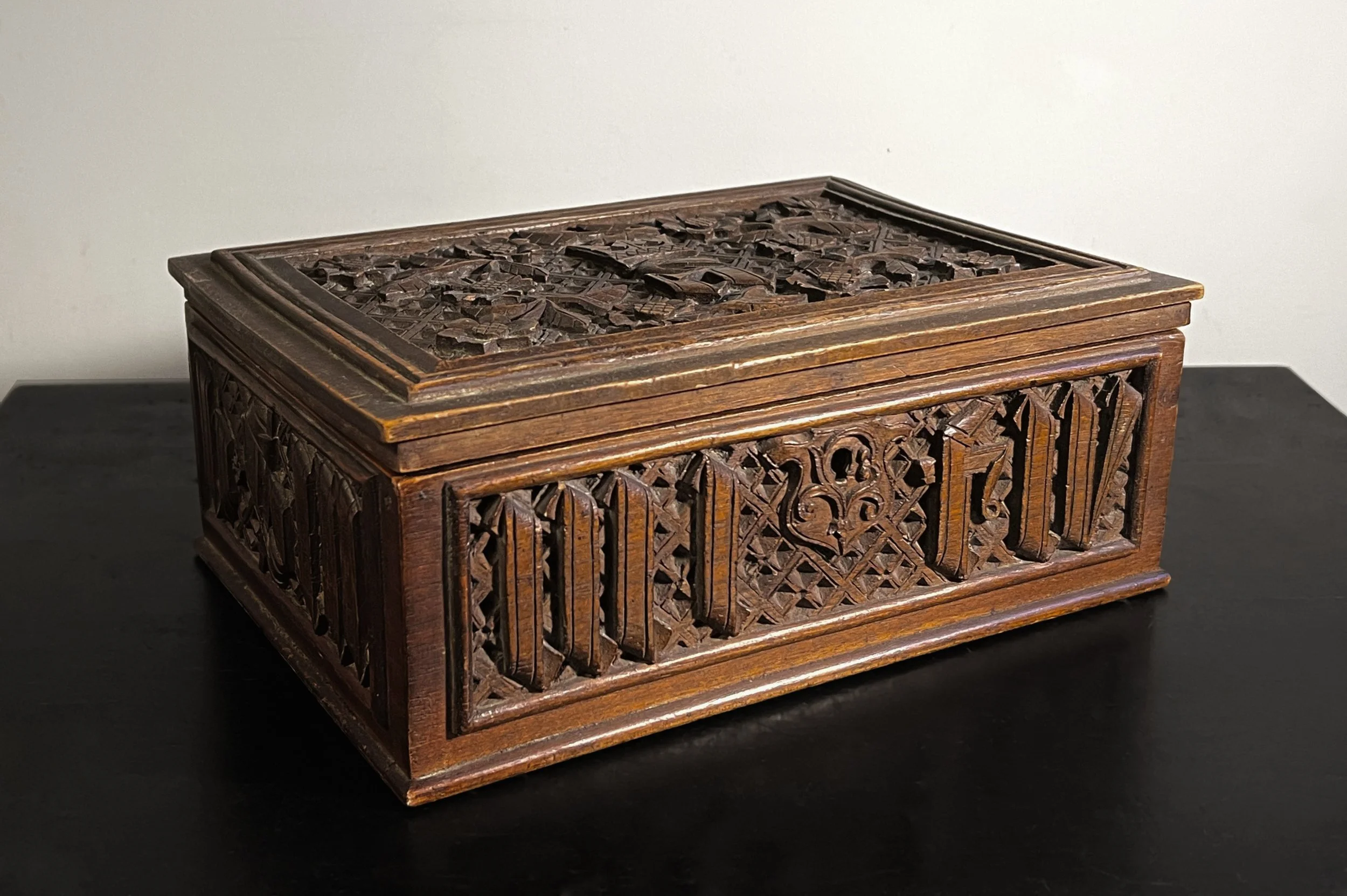
This 18-19th century casked is faithfully executed in true Gothic-style of the traditional betrothal caskets of the 14-16th centuries. Featuring well carved gothic script on each side ant the lid featuring various Alpine flowers surrounding a crowned "A". These flowers vary in petal count, and could variously be rhododendron, blue flax, edelweiss and myrtle flowers, all found in the region with long held associations to marriage customs. There are many similar examples found in Northern Europe and Germany, the Rhine Valley region.
It is unusual to find an 18-19th century "revival" casket of this style. Typically revival pieces of the 19th century, which can may be faithful copies of earlier works, tend to depart into a fantasy inspired by these earlier periods. This example, aside from the later hinges and lock and possibly the carved escutcheon, are faithful to the source and suggests a continuity of the tradition of a betrothal casked as a wedding gift from groom to bride during courtship.
9.5 x 3.625 x 6.5 in (24.13 x 9.3 x 16.6 cm)
Condition:
Excellent. Slight bowing in the lid with minor stress. Lacking key.
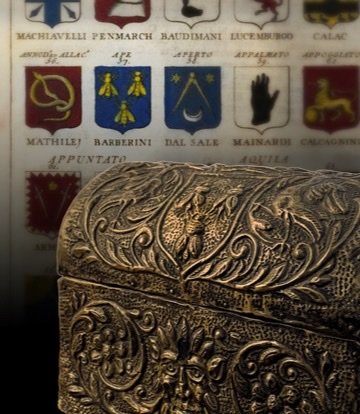
Chased brass sheet with designs in relief over a wooden body. The lid features a shield with three bees, the coat of arms of the Barberini family, flanked by two birds and surmounted by a coronet. The reverse depicts a Green Man. The lower front portion displays a Green Man motif, complemented by stylized flowers and scrolling motifs. The back features a bird within a circular cartouche. Swirling vines and leaves are present throughout.
Marks: Barberini Coat of Arms: "The Barberini College in Ravenna has for its emblem a gold lion lying down with its head turned toward twelve bees of the same metal flying above it, set against a blue field. The lion is taken from the coat of arms of the city of Ravenna, and the bees are derived from that of Cardinal Francesco Barberini, as he was the founder of this College."(p. 196)
"APE - 57. Barberini di Roma nello scudo di azzurro, tre api d'oro col volo abbassato."
("Bee – 57. The Barberini of Rome, in a blue shield, feature three gold bees with their wings lowered.")(p. 183)(shield Illustrated p. 182)
7 x 5.25 x 4 in (17.78 x 13.4 x 10.2 cm)
Condition: Wear to hinges and interior.
Conservation: Brass rubbed and blackened. Old repairs to interior.
Literature: Ginanni, Marco Antonio. "L'arte del Blasone Dichiarata per Alfabeto. Con le figure necessarie per la intelligenza de' termini in molte tavole impresse in rame e tre indici, due delle voci in francese, e latino, uno de' nomi delle famiglie, comunità e società, di cui vi sono l'arme blasonate. Del conte Marc'Antonio Ginanni. Italy: presso Guglielmo Zerletti", 1756.
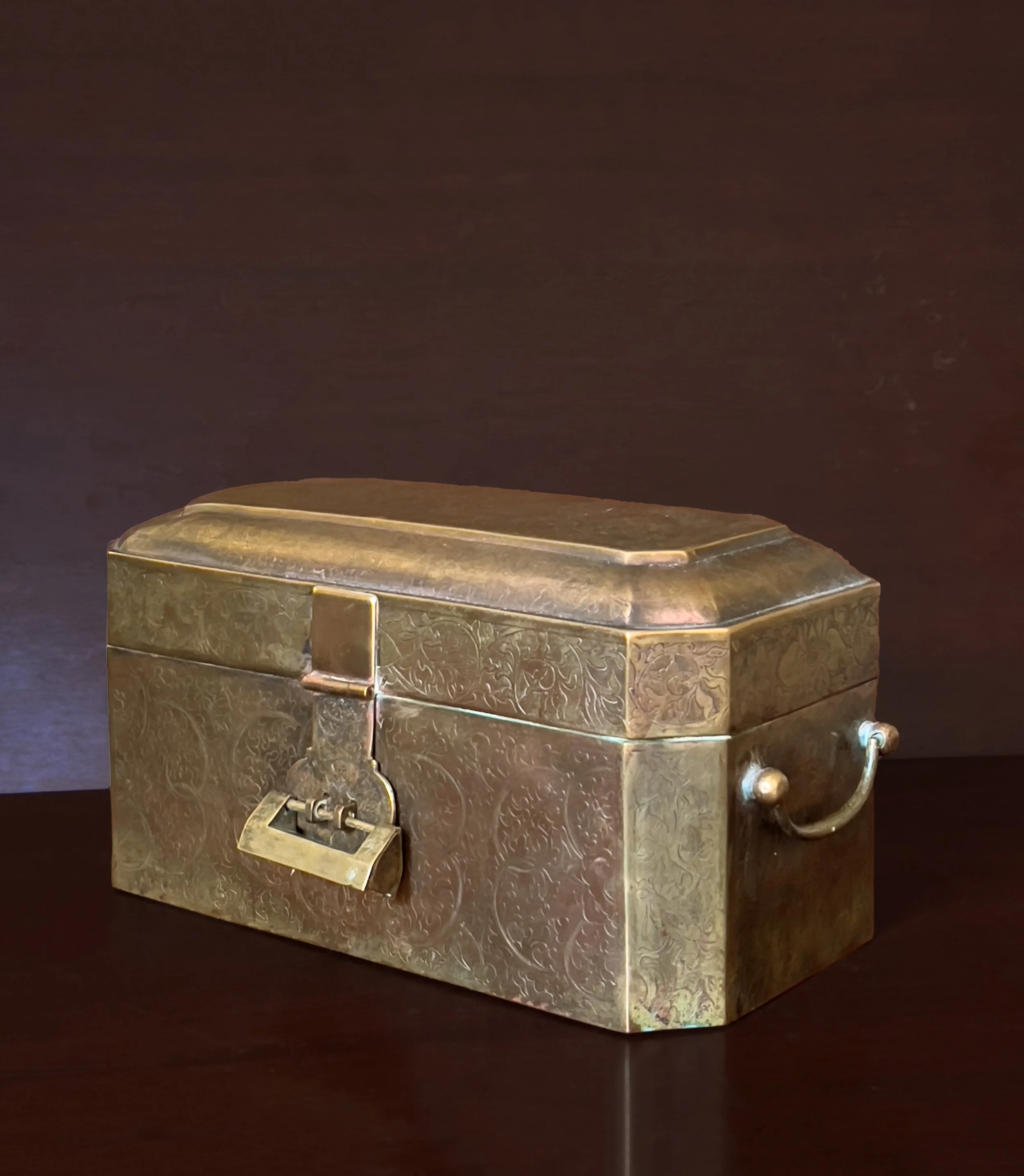
The engraved scenes on all sides and lid of this well-made casket are traditional Chinese motifs. The casket was made for the European export market and blends elements of European and Chinese styles and designs. Lined in blue velvet with a removable tray. Original padlock and keys present.
The form of this casket takes influence from both Chinese and European forms, and notably there are two locking devices: one a traditional Chinese padlock and hasp, which covers the European skeleton key inbuilt lock. A unique moment in time merging both of these worlds.
Marks: Apparently unmarked.
12 x 6.5 x 6.5 in (30.48 x 16.6 x 16.6 cm)
Condition: Polished and waxed
Conservation: Interior velvet re-glued.
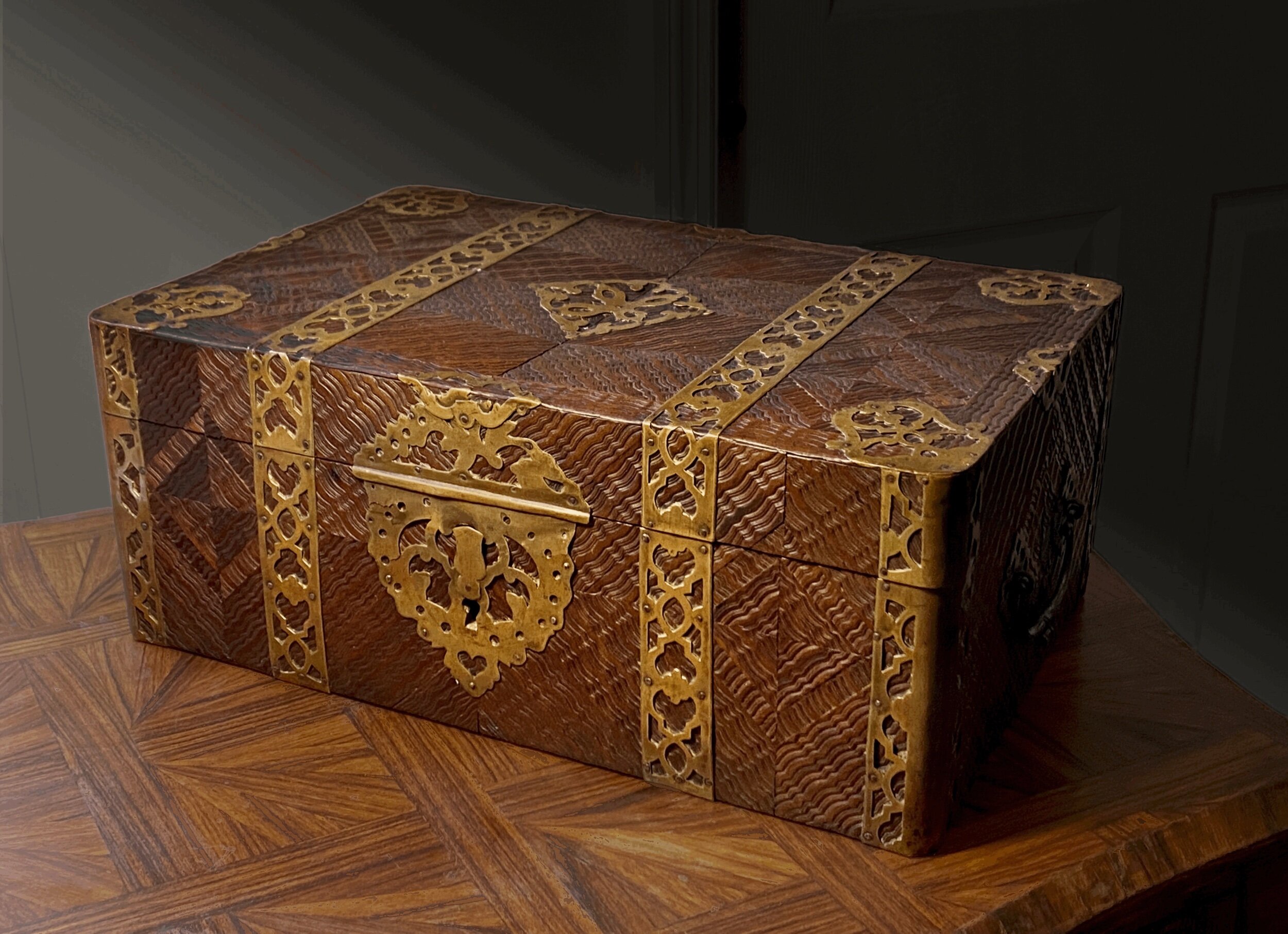
A highly unusual travel desk. Similar in style to Dutch ripple molding, the veneer panels on the exterior of the case would have been carved by passing wood through a specially shaped scraper blade with repetitive passes. With this technique, the contour of the scraper blade imparts the uniform carved form throughout. Multiple compartments inside for storage. Includes replaced keys.
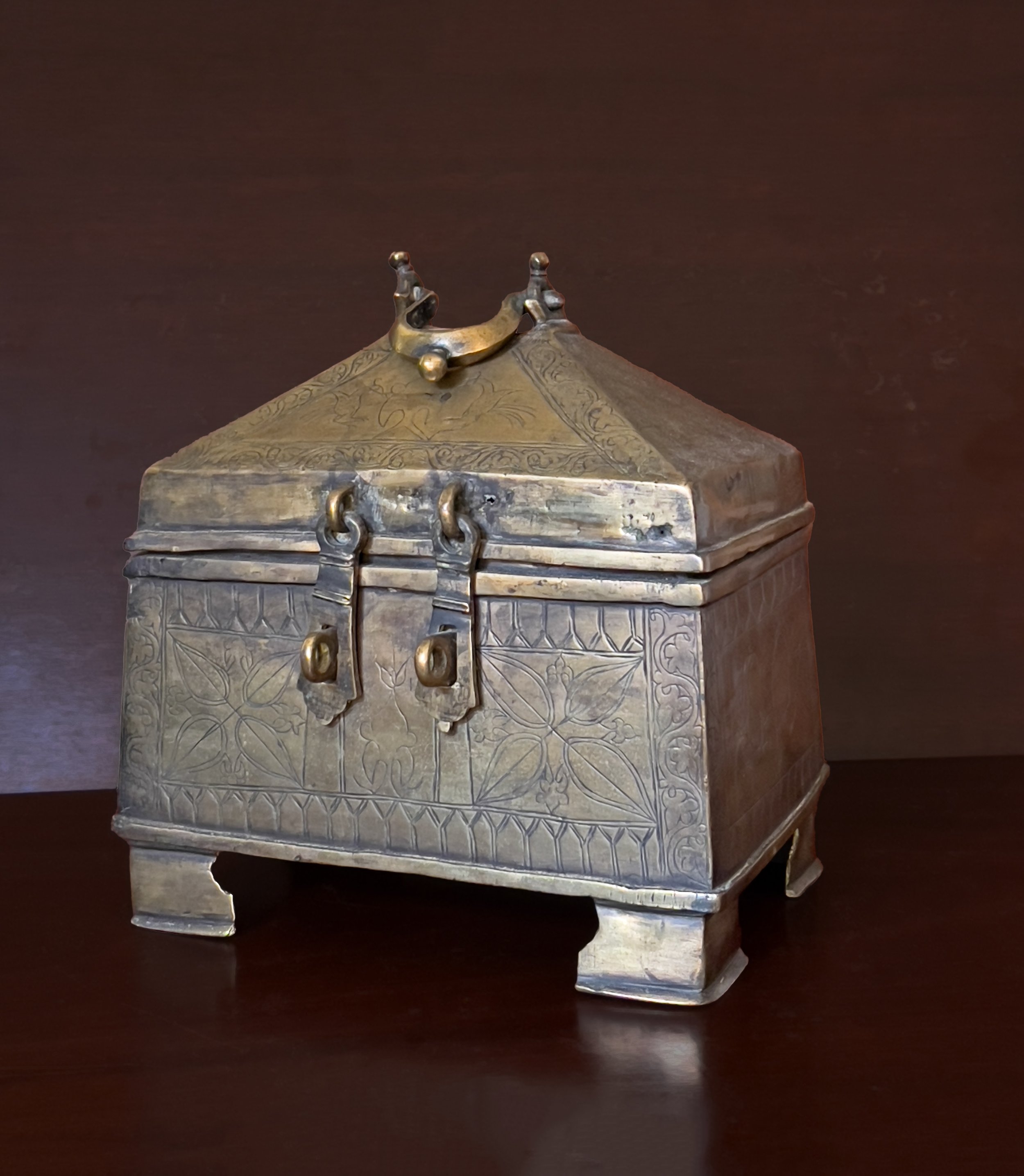
Engraved cast brass casket, probably from Northern India. Of rectangular form on four corner feet, with a hinged coffered lid and handle, and a pair of latches. The body and lid feature various engraved floral and bird motifs. The form borrows from early Islamic casket designs.
Marks: Apparently unmarked.
10 x 11 x 7 in (25.4 x 28 x 17.8 cm)
Condition: Rubbed and polished. Traces of polish.
Conservation: Waxed
Literature: For 17th century example see Christie's. Auction 7959: Art of the Islamic & Indian Worlds. April 2011.
For 19th century example in the Philadelphia Museum of Art. Accession Number: 1994-148-371
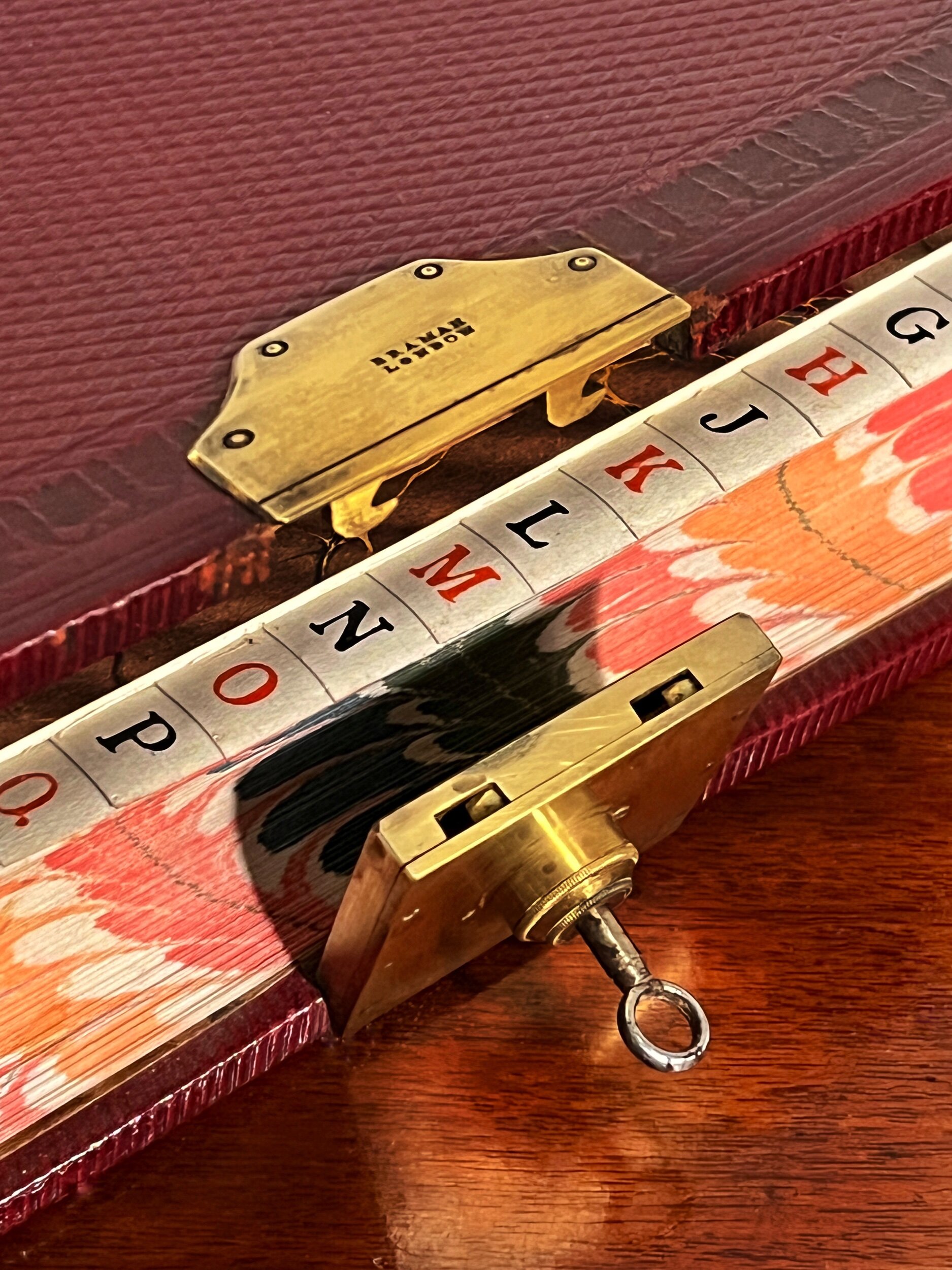
Large heavy and remarkably still blank red leather bound Private Ledger book. Substantially well made along with functioning high-quality brass Bramah & Co. lock and original key. Spine reads "Private Ledger D.A. & Co. Ltd. and in oval cartouche the maker name of "F. Leslie & Co. Manufacturers 40 Fahn St. EGL"
Bramah locks are known for being "unpickable" and were used on high end goods in the 19th and early 20th Centuries. The Bramah lock was created by Joseph Bramah in 1784. The lock employed the first known high-security design. A completely unused original ledger book in excellent condition along with a high quality Bramah lock is a rare find. The keys for Bramah locks are very unique and difficult to replace - you would not be able to go through spare keys of the same size hoping one will work - so it is fortunate the original key is still present here.
10.5 x 15 x 2.5 in (26.67 x 38.1 x 6.4 cm)
Conservation:
Brass lock has been polished.
Literature:
*Illustrations: Rudimentary Treatise on the Construction of Locks, Hobbs, A.C., 1853
*(Illustrations are not included)
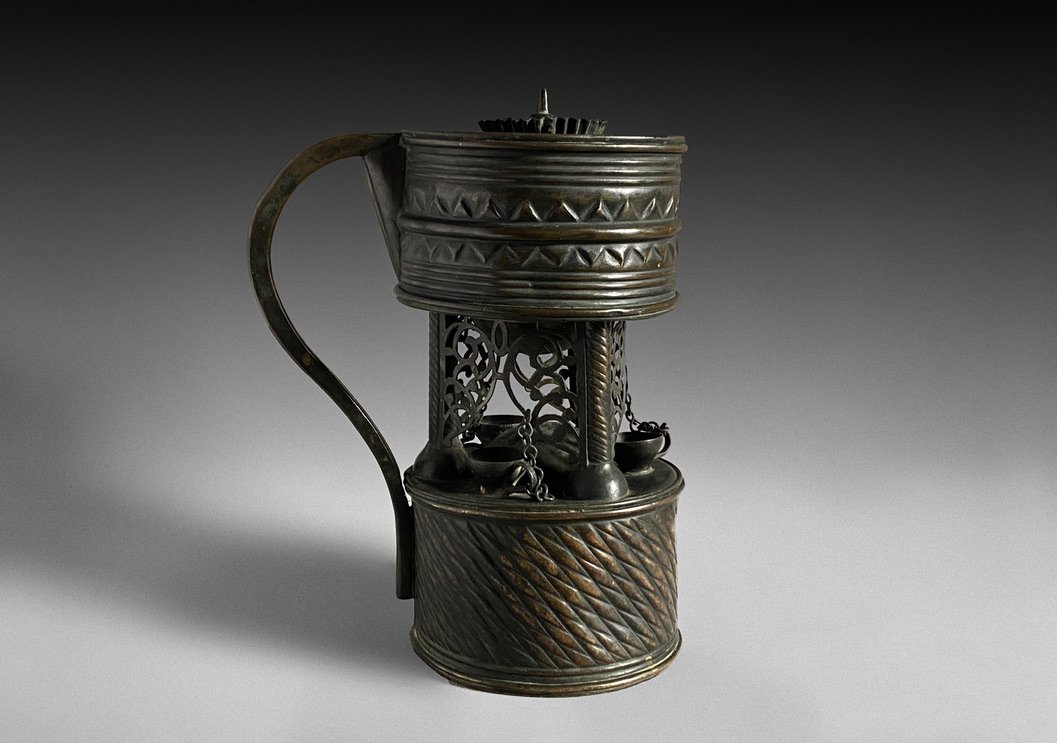
This highly unusual and rare, possibly unique, pneumatic table fountain takes the form of a sabil or shadirvan (public drinking fountains and ablution fountains) found at cross roads, on building facades and within Mosques. Here pipes are concealed in the upper and lower tanks that move water via air pressure and gravity to automatically raise and spray water from the top fluted basin. The use of miniaturized architecture, with a long tradition in Islamic culture, added to the entertaining and delightful effects of this marvel. The fountain may have had a role in celebrations, using perfumed waters.
The craftsperson who made this object was clearly influenced by, and most certainly had access to, copies of some important texts such as: Heron of Alexandria’s “Pneumatica”, c. 50 CE., the The Banū Mūsā brothers, “Book of Ingenious Devices”, 850 CE., and Ismail al-Jazari “Book of the Knowledge of Ingenious Mechanical Devices”, 1206 CE., amongst other works by polymaths from antiquity through the medieval period emerging within the Islamic world.
The assembled metal parts are made of tinned-copper alloy sheet with lead soldered seams, traces of gold gilding and appear to conform to the step-by-step instructions for fabricating similar devices described within al-Jazari “Book of the Knowledge of Ingenious Mechanical Devices”.
This object bears many stylistic affinities to Islamic sabil (drinking fountains) and shadirvan (ablution fountains) erected during the Ottoman Empire from 16th century onward. There may be further links to the city of Diyarbakır, where al-Jazari worked at the Artuqid court of Nasir al-Din Mahmud at the Artuklu Palace in the 13th century. The architectural vernacular of this city has design elements seen on this object.
*Contemporary (21st C.) drawing of the presumed cross section interior based on comparative analysis of Heron and al-Jazari’s manuscripts.

A wedding box made from pasteboard, sewn together and stiffened and covered over with block printed polychrome domino wallpapers known as Papiers Dominotés in France. The hand carved woodblock used to create the graphic black outlines within the printed imagery feature flowers, pomegranates and foliage tinted with green and red hues and accented with red paint on the edges of the carcass. The box sits nicely atop turned wooden feet. The original functional lock is typical 17th century lock design for a casket. The bottom panel of paper has an 18-19th century sheet of domino paper. Partially visible on the base is the paper atelier which most likely reads "Paris Chez a Associés", one of several such houses producing such wallpapers throughout the 17-19th centuries. An example in original condition that has survived is rare given the ephemeral nature of paper products.
15.5 x 9.5 x 10 in (39.37 x 24.2 x 25.4 cm)
Condition:
Wear to the front right corner and general wear commensurate with age throughout. Feet possibly a later 19th century addition. Key a replacement.
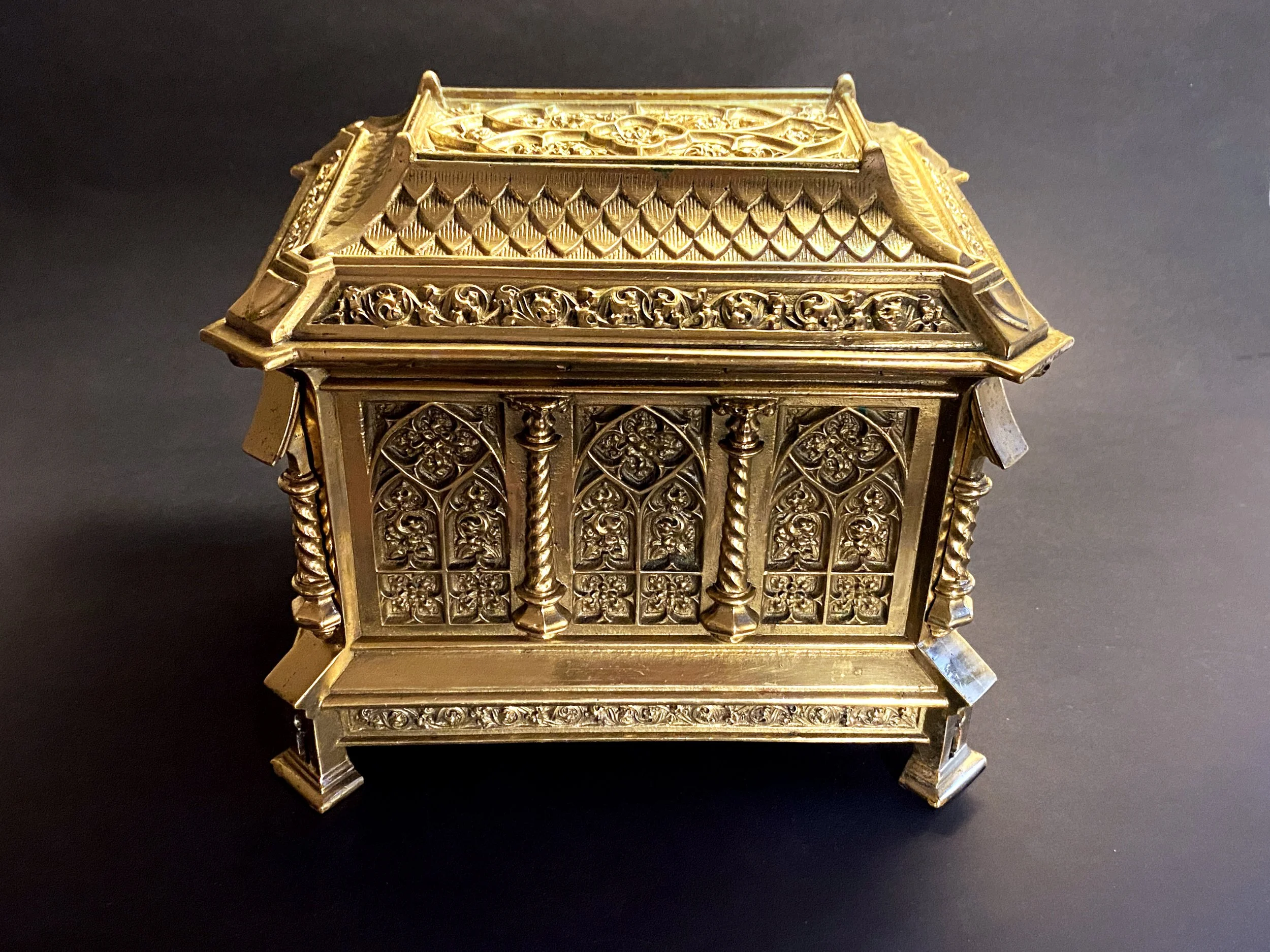
A heavy brass casket in the form of a Gothic cathedral. The body is deeply cast with arched windows and buttressed columns. It is lined in green velvet with a velvet tray insert.
A fanciful object that captures the 19th-century fascination with the Gothic Revival in architecture.
Marks: Apparently unmarked.
8.5 x 7.5 x 6.25 in (15.9 x 19.1 x 15.9 cm)
Condition: Lacking lock. Wear to interior green velvet.

Rare 18th century box with sliding lid box made of burled wood with with extremely fine detail in the chased metal mounts with traces of gilt. Set with glass paste gemstones imitating coral, lapis and turquoise. Lined with yellow silk on the interior and base, featuring five claw dragon roundels. The box is in good condition with some lifting of mounts, minor reguling, some gems lacking. 10.5L x 5w x 1 5/8t in

This well made leather-bound box features a solid construction and lock, requiring two full turns of the key to lock. The latches and lock are snug and secure. Possibly a despatch box, originally used for private documents. Covered in green leather, in good condition overall with only light wear, lid has a old stain. This versatile piece could be well suited for a jewelry collector today. With stepped inserts, which could support an added tray. 17L x 9.5d x 4t in interior: 16 5/8 x 8 7/8in and 2/38in
Bramah Padlock with pair of original keys. Signed “J. Bramah” “Patent”, reverse engraved differ no. “579”. Brass and iron. By Bramah Lock Company, London. 18th c. (Made circa 1784–1798, probably at 124 Piccadilly). Provenance: D. Taylor Collection.[1][2]
Bramah Security Equipment Ltd. in London still operates today and has reviewed this padlock and its original keys against its internal archive records, dating the set to 1784–1798. This padlock represents a rare early 18th c example of the famous locksmith’s design.[1]
Early locks were stamped “I (or J) Bramah. Patent”. “J. Bramah” and “Patent” are stamped on the front of this padlock, matching the early marking configuration documented in Bramah’s own chronological history for the first period of the Bramah Lock Company, when the firm was operating from 124 Piccadilly.[2][1]
The “579” engraved on the reverse in copperplate roundhand is, in the company’s assessment today, probably a differ number – a system the firm still uses as the specific identifier for a lock’s unique key, registered by the company and reproducible only against a verified client signature on file.[1]
These elements, taken together with hand-assembly marks such as a “V” register mark on the underside of the shackle and the use of iron keys (later replaced by steel), place this padlock in the company’s early, largely hand-made phase.[2][1]
Patented by Joseph Bramah (1748–1814) in 1784, his design was one of the first true high-security locks. The lock’s signature brass raised cylindrical keyhole could be found on his padlocks, securing luggage, writing boxes, ledger books, and fine furniture, and the basic design remains in use today. In the same year he started the Bramah Lock Company, soon moving to 124 Piccadilly in London. In the early years, before Henry Maudslay – now regarded as a founding father of the machine‑tool industry of the Industrial Revolution – joined the firm in 1789 to mechanise production, the locks were made and assembled largely by hand in small numbers.[3][4][5][2]
Bramah’s Challenge: “The artist who can make an instrument that will pick or open this lock shall receive 200 guineas the moment it is produced.”[5][6]
By 1790 Bramah turned the lock’s reputation for being unpickable into public theater by hanging a painted sign and a special “challenge padlock” in the window at 124 Piccadilly, offering a reward of 200 guineas to anyone who could pick it open. This challenge padlock used 18 sliders rather than the usual four to six, yielding more than 470 million possible key permutations and making the chance that two keys would operate the same lock effectively nil.[6][5]
In 1851, more than sixty years after Joseph Bramah issued the challenge, Alfred Charles Hobbs arrived in London as the representative of Day & Newell of New York to demonstrate their Parautopic safe lock at the Great Exhibition; his unexpected public defeat of a Chubb Detector lock on the vault door of the Depository of Valuable Papers in Westminster in 25 minutes before eleven witnesses made headlines.[7][8][9]
Hobbs later took on Bramah’s challenge padlock. It took 51 hours over 16 days, with custom tools, for Hobbs to pick Bramah’s challenge padlock and claim the prize. The event was widely reported under headlines such as “The Pick Lock Question” and later remembered as the Great Lock Controversy, a spectacle that ultimately underscored both the ingenuity of Bramah’s original design and the shifting standards of security in the mid‑nineteenth century that followed its defeat.[9][10][5]
Sources
[1] [PDF] A Chronological History of Bramah Locks 1784 to 2002 https://www.bramah.co.uk/Chronological%20History.pdf
[2] Bramah - Antique Box Guide https://www.antiqueboxes.org/bramah/
[3] [PDF] Industrial biography : iron workers and tool makers https://archive.org/download/industrialbiogra00smiluoft/industrialbiogra00smiluoft.pdf
[4] Joseph Bramah by Samuel Smiles - Graces Guide https://www.gracesguide.co.uk/Joseph_Bramah_by_Samuel_Smiles
[5] Bramah's 'Challenge Lock' - Antique Box Guide http://www.antiquebox.org/bramahs-challenge-lock/
[6] Bramah lock - Wikipedia https://en.wikipedia.org/wiki/Bramah_lock
[7] Newell Parautoptic Lock - 1851 - Historical Safe Locks and Keys https://safelockcollector.com/safe-locks/newell-parautoptic-lock-1851/
[8] Chubb Detector Lock - Antique Box Guide https://antiqueboxes.org/chubb-detector-lock/
[9] Hobbs and His Lock Picks: The Great Lock Controversy of 1851 http://www.todayifoundout.com/index.php/2014/06/great-lock-controversy-1851/
[10] The Man Who Picked Victorian London's Unpickable Lock https://www.mentalfloss.com/article/501820/man-who-picked-victorian-londons-unpickable-lock